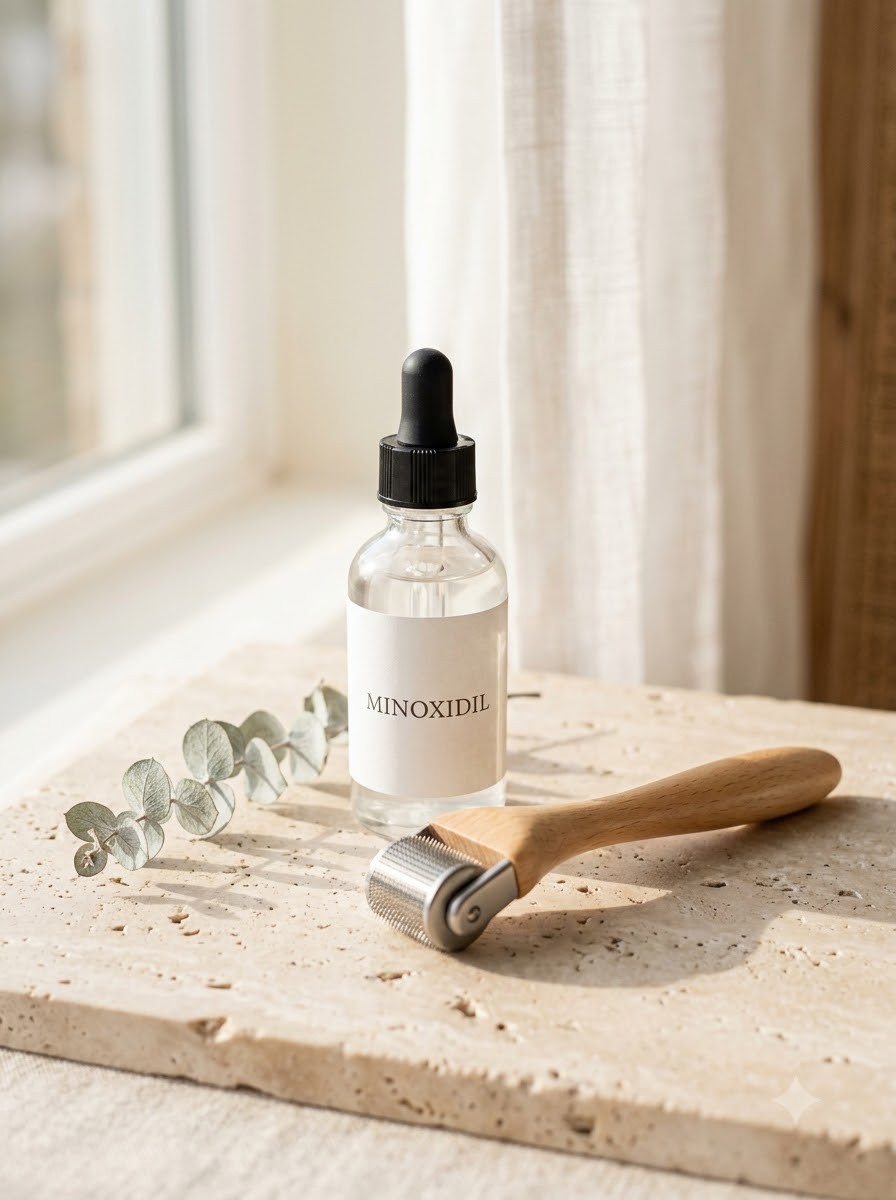
Quick answer
- A Korean doctor says a clinical trial found that adding a 1.5mm derma roller to a minoxidil routine raised hair count by 91 per square centimeter, compared to just 22 with minoxidil alone.
- A Korean doctor says microneedling creates tiny openings in the scalp's outer layer, which significantly raises how much topical minoxidil the skin can absorb.
- A Korean doctor says a needle depth of around 0.5mm is considered the most scientifically sound choice for home use, as it activates the skin's repair and absorption pathways without risking damage to follicle stem cells.
- A Korean doctor says people with severe scalp inflammation should avoid microneedling devices, as using them can make the condition worse.
What the clinical evidence says about pairing minoxidil with a roller
Two Korean doctors point to clinical data suggesting that adding microneedling to a minoxidil routine produces meaningfully better outcomes than minoxidil on its own.
One doctor highlights a 2013 randomized controlled trial in which participants using minoxidil alone gained an average of 22 additional hairs per square centimeter, while those who also used a 1.5mm derma roller gained 91 — roughly four times as many.
A separate doctor notes that a study conducted over 12 weeks similarly found that combining microneedling with 5% minoxidil led to a significantly greater increase in hair count than minoxidil by itself.
The underlying reason, according to one of the doctors, is mechanical: microneedling punches micro-holes through the scalp's stratum corneum, the outermost barrier layer, and those openings substantially increase how much of a topical product like minoxidil actually reaches deeper tissue.
Beyond absorption, a Korean doctor explains that the micro-injuries themselves set off a biological response — the body releases natural growth factors and activates cell signaling pathways that can wake up dormant hair follicles.
One doctor frames the broader principle this way: delivering nutrients and active ingredients directly into the dermis through home microneedling, rather than relying on surface application alone, can meaningfully amplify results.
Which needle depth is safest and most effective for the scalp
Needle length is one of the most consequential decisions when choosing a microneedling tool for hair concerns, and Korean doctors offer specific guidance on where the risk-benefit line sits.
The range most commonly used in hair-loss protocols runs from 0.5mm to 1.5mm, according to one doctor.
However, a doctor cautions that going deeper than 1.5mm carries real risk: follicle stem cells sit roughly 1.0mm to 1.8mm beneath the scalp surface, and needles that penetrate beyond 1.5mm can tear and destroy those cells, potentially causing scarring and fibrosis.
On the other end of the spectrum, a large-scale meta-analysis cited by the same doctor found that shallower needles — around 0.5mm — actually outperformed deeper ones, producing more than twice the improvement in hair count compared to 1.5mm needles.
That doctor identifies approximately 0.5mm as the most scientifically supported depth for home use: shallow enough to leave follicle stem cells unharmed, yet sufficient to fully activate the skin's wound-recovery response and open absorption channels for topical products.
Rollers versus stamps: technique differences and limitations
Not all microneedling tools work the same way on the scalp, and Korean doctors flag some practical drawbacks specific to the rolling format.
Because a derma roller moves across the skin in a rolling motion rather than pressing straight down, it can snag and cut existing hairs, and the angled entry of the needles may prevent them from reaching the depth the label suggests.
A doctor echoes this concern, noting that the rolling motion can break hairs and may fail to deliver needles to an adequate depth.
That same doctor adds that manual rollers and home devices more broadly suffer from high variability — differences in how hard a user presses and how consistently they angle the tool mean results can vary widely even when the needle length is identical.
A derma stamp, which presses straight down rather than rolling, sidesteps some of these issues. One doctor advises pressing the stamp gently two to three times per section and not fixating on drawing blood as a sign of effectiveness.
Regardless of which tool is used, a doctor stresses that dermarollers and dermapens must be disinfected with alcohol before each session to prevent bacteria from entering the open pores and causing a secondary infection.
Aftercare rules and who should skip microneedling entirely
How you care for the scalp immediately after a microneedling session matters as much as the technique itself.
A Korean doctor advises skipping the shampoo entirely on the day of the procedure — going to sleep without washing — because water and shampoo entering the fresh puncture holes can cause irritation and raise the risk of infection.
On the question of who should avoid these tools altogether, a doctor is direct: anyone dealing with severe scalp inflammation should not use microneedling devices, as doing so risks making the inflammation significantly worse.
This article is based on our research into Korean-language videos by skincare professionals. It is general information, not medical advice. Disclaimer.
